
If you operate a tennis club, you’ve probably felt the squeeze: more demand for court time, less tolerance for weather cancellations, and higher expectations for year-round programming.
That’s why “tennis court tents” (also called covered courts, court canopies, or clearspan sports structures) are showing up in more club master plans. For many facilities, covering courts isn’t a cosmetic upgrade—it’s a capacity and reliability strategy.
Below is what’s driving the trend in the U.S., what a “court tent” actually means in practice, and the early questions clubs should answer before calling vendors.
The shift: covered courts are becoming a capacity strategy
Tennis participation in the U.S. has been rising for several years, which puts real pressure on available court hours—especially at clubs that run leagues, instruction, and events. The USTA highlighted record participation in its 2024 reporting, including in its 2025 update on U.S. tennis participation reaching 25.7 million players in 2024.
More players doesn’t automatically mean every club is “full,” but it does tend to produce the same operational outcomes:
- Prime-time slots get crowded.
- Leagues and ladders compete with lessons and private bookings.
- Weather-related cancellations become a bigger revenue and customer experience problem.
- Expansion options (new courts, new land) are limited or slow.
A covered-court investment is often a way to create more reliable playable hours without changing the footprint of the facility.
The operational pain that pushes clubs to cover courts
For most clubs, the decision starts with one word: predictability.
Outdoor tennis is vulnerable to rain, wind, glare, and temperature swings. That variability hits clubs in ways that aren’t always obvious on a spreadsheet:
- Cancellations create administrative drag. Rebooking, refunds, and member complaints stack up quickly.
- Programming becomes fragile. Leagues, camps, and academies need dependable schedules.
- Staffing gets harder. If lessons are constantly shifted, your teaching team’s time (and your payroll) gets inefficient.
- Court utilization becomes uneven. Some weeks are oversold, others under-used, and planning becomes reactive.
Covered courts reduce the “operational noise.” Even a partial roof or a seasonal enclosure can stabilize your calendar.
Weather volatility is changing the risk math
This isn’t only about winter. Across many regions, clubs are dealing with more frequent operational disruptions from extreme heat, air-quality events, and heavy precipitation.
For example, the U.S. EPA discusses compounded health risk when heat and smoke overlap in its guidance on co-exposure to wildfire smoke and extreme heat. Meanwhile, Project Play has documented how climate conditions are changing the way sports are scheduled and played, including the shift to safer times of day, in “Climate change is impacting how children play sports” (2025).
You don’t need to be in a wildfire zone to feel the effect. If you’ve ever had:
- a week of unsafe AQI,
- a stretch of heat advisories,
- repeated rainouts during a league season,
…you’ve already experienced the “reliability premium.” Covered courts can be a way to buy back schedule certainty.
Key Takeaway: Clubs don’t invest in court tents just for comfort—they invest to protect programming reliability and revenue predictability.
What people mean by “tennis court tents” (and the main options)
The phrase tennis court tents can describe several different structure types. The right choice depends on climate, budget, timeline, aesthetics, and how permanent you want the asset to be.
Option 1: Air-supported bubbles and seasonal domes
Air-supported structures (often called “tennis bubbles,” or an air-supported tennis dome) are pressurized enclosures that cover one or multiple courts. Many clubs use a tennis court bubble as seasonal winter coverage and can install and remove it on a schedule.
Pros (typical):
- Faster to deploy than permanent buildings
- Often a lower upfront investment than rigid indoor construction
- Lets a club keep the “outdoor court” asset and add winter capacity
Trade-offs (typical):
- Requires ongoing operation (air systems) and careful planning for local weather loads
- Community/aesthetic acceptance varies by location
- Energy/comfort outcomes depend heavily on design choices and local climate
A neutral explainer that defines and describes this category is Sports Interiors’ overview of air structures for indoor tennis (“tennis in a bubble”).
Option 2: Clearspan fabric structures (tension / aluminum-frame sports tents)
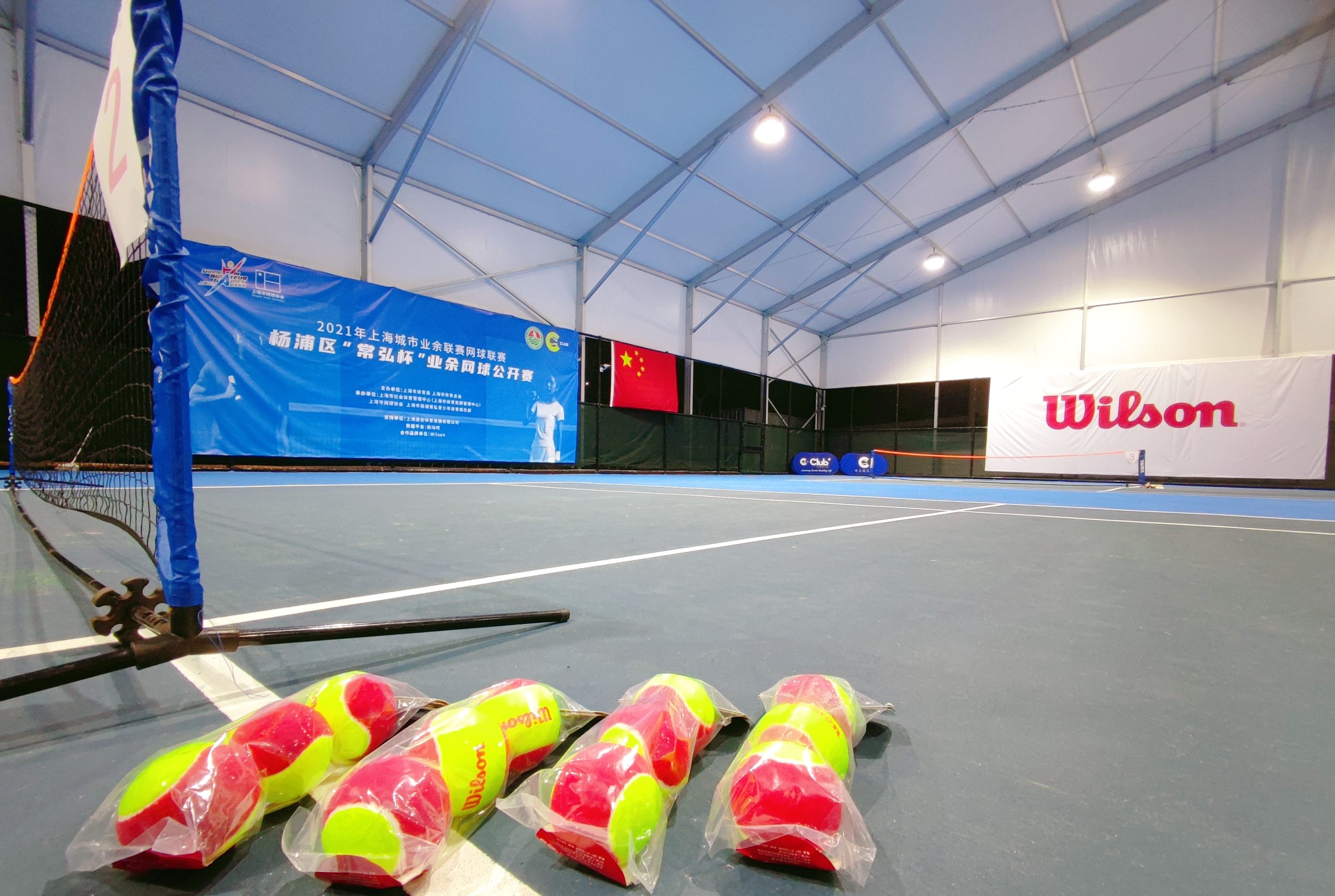
This is where many people use the term “court tent” most literally: a clearspan roof-and-frame system (often aluminum frame + tensioned fabric membrane) designed to cover courts while keeping the interior open.
Pros (typical):
- Clear interior spans (no center columns interrupting play)
- Modular designs can make expansion or relocation possible
- Can create an “indoor-like” environment while still feeling lighter than a conventional building
Trade-offs (typical):
- Permitting and engineering requirements are still real; it’s not “just a tent”
- Performance depends on site-specific loads (wind/snow) and anchoring/foundation design
- Lighting, ventilation, and condensation control must be designed—not improvised
As one example supplier category, JM TENT offers a product specifically positioned for this use case: the Aluminum Structure Tent for Tennis Sport Court.
Option 3: Permanent indoor tennis buildings
Traditional indoor tennis courts inside rigid construction facilities are the most permanent choice, and they can support a premium member experience with full amenities.
Pros (typical):
- Long-term asset with strong enclosure, acoustics potential, and amenity integration
- Easier to standardize comfort expectations (HVAC, lighting, insulation)
Trade-offs (typical):
- Longer timelines and higher capital costs
- More complex construction disruption
Quick comparison (high-level)
| Option | Typical permanence | Typical timeline | Best for | Watch-outs |
|---|---|---|---|---|
| Air-supported bubble | Seasonal or semi-permanent | Fast | Winter coverage, quick capacity | Operations, energy, weather planning |
| Clearspan court tent (fabric/aluminum) | Semi-permanent | Medium | Multi-season reliability without full building | Engineering, permitting, detailing |
| Permanent indoor building | Permanent | Slowest | Premium year-round facility | Cost, disruption, long permitting |
Note: Always treat wind/snow loads, permitting, and final specs as site- and jurisdiction-dependent. For many projects, stamped engineering is part of doing this safely.
The business case: utilization and revenue smoothing
Covered courts tend to pay off (or fail) for the same reason any facility investment does: utilization.
The best operators evaluate covered-court projects with a simple question:
How many additional high-quality, bookable hours does this create—and how reliably?
That shows up in a few common wins:
- More sellable winter hours (in cold-weather regions)
- Fewer cancellations and refunds during rainy seasons
- More stable lesson revenue (coaches can teach on schedule)
- More dependable leagues and events (which improves retention)
Even in broader racquet facility economics, research-oriented facility planning content emphasizes that fixed costs don’t scale down nicely—and that predictable court access enables programming density. Racquet Sports Institute argues that facility economics often hinge on utilization and programming rather than court rentals alone in its 2026 piece on economies of scale in racquet sports facilities. (That article isn’t tennis-tent-specific, but the operational logic transfers.)
Early-stage checklist before you call vendors
If you’re still in the “should we even explore this?” phase, this checklist will save you time—and reduce expensive rework later.
1) Clarify the operational goal
- Are you trying to add winter play, reduce rainouts, or create premium year-round programming?
- Is this for member retention, public bookings, instruction revenue, or all three?
2) Define what “covered” needs to mean
- Roof-only shade/rain protection?
- Fully enclosed winter play?
- Climate-controlled “indoor-like” environment?
The tighter your definition, the easier it is to evaluate options fairly.
3) Map the site and constraints
- Court layout, setbacks, and access for install equipment
- Drainage and prevailing winds
- Neighbor concerns (lighting spill, appearance, noise)
4) Treat permitting and engineering as first-class workstreams
This is where many projects succeed or fail.
- Which code path applies locally?
- What are the wind and snow load requirements?
- What documentation will the inspector want (drawings, calculations, material specs)?
⚠️ Warning: Don’t accept “rated for X wind” as a one-line promise. Ratings and approvals are jurisdiction- and site-dependent; the safe answer usually includes engineered design and stamped calculations.
5) Plan the “facility experience” details early
- Lighting quality and glare control (especially if you’re enclosing translucent materials)
- Ventilation / HVAC approach (comfort + condensation)
- Acoustics (some enclosures amplify ball impact noise)
- Egress, access control, and how you’ll operate the space safely
6) Decide how you’ll operate through installation
- Can you close courts temporarily without harming peak-season revenue?
- Can you phase the project (cover some courts first)?
Where JM TENT can fit (as one example) and what to ask for
At the awareness stage, you don’t need a vendor pitch—you need clarity on what “good” looks like.
If you’re comparing suppliers, start by asking for documentation and decision inputs rather than marketing claims:
- Example structures similar to your span and court count
- Engineering approach for your jurisdiction’s wind/snow loads
- Anchoring/foundation concept (site dependent)
- Fabric/membrane specs and maintenance expectations
- Install timeline assumptions and what drives them
JM TENT’s sports-structure catalog is organized under its Products category and it also maintains a dedicated tennis court tent tag page to browse relevant structures.
Next steps
If you’re seeing consistent weather-driven disruption or growing court-time pressure, a covered-court feasibility check is usually the right first move.
A practical next step is to request a short concept-level package (not a full design): target spans, enclosure type, a rough install approach, and the documentation path you’ll need for permitting.
If you’d like, JM TENT can help you evaluate various court-covering options and determine the necessary documentation. We’ll start by identifying the type of structure that’s most suitable for your specific seasonal needs and timeline.
